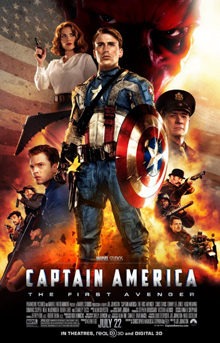
Directed by Joe Johnston
Written by Christopher Markus and Stephen McFeely
Cast
Chris Evans as Steve Rogers/Captain America
Tommy Lee Jones as Chester Phillips
Hugo Weaving as Johann Schmidt/Red Skull
Hayley Atwell as Peggy Carter
Sebastian Stan as James "Bucky" Barnes
Dominic Cooper as Howard Stark
Neal McDonough as Timothy "Dum Dum" Dugan
Derek Luke as Gabe Jones
Stanley Tucci as Abraham Erskine
Kenneth Choi as Jim Morita
Bruno Ricci as Jaques Dernier
J.J. Feild as James Montgomery Falsworth
Toby Jones as Arnim Zola
Richard Armitage as Heinz Kruger
Samuel L. Jackson as Nick Fury (cameo)
Out of all of the movies in the run-up to The Avengers, Captain America was the one I was most skeptical of. The whole patriotic flag-waving American thing just isn't something that I can relate to, especially when the costume is so gaudy, old-fashioned, and - unlike other superheroes - barely changed in the last 70 years. Of course, patriotism has been a big part of every superhero that debuted in that era, in which villains were invariably German or Japanese, and then a little later Russian and Chinese, but with Captain America... just his name makes it all that more blatant. Especially as most other superheroes have grown over the years to be flawed, and have the same issues that any ordinary human would have, and from what I can see, Cap has remained the idealist he was at his conception. Needless to say, I didn't bother going to see this movie at the cinema.
This decision turned out to be a big mistake, because not only is Captain America: The First Avenger a far better film that I expected, but it's also my favourite out of all of the movies produced by Marvel Studios so far. Joe Johnston took the 40's setting and ran with it, making a huge piece of pure fun entertainment not seen since Indiana Jones And The Last Crusade.
Chris Evans plays Steve Rogers. A short, scrawny asthmatic who doesn't have the physical specifications to be able to join the army and fight the Nazi's. What he does have, though is the heart and determination. Both of which are noticed by defected German scientist Abraham Erskine, creator of a serum to create a supersoldier. The serum has been used once before - by Johann Schmidt, the head of a secret Nazi group called H.Y.D.R.A. - but although it gave him the increased strength, speed and agility it also left him deformed. After going through boot camp, where Col. Chester Phillips dismisses Rogers out of hand, Steve finally goes through the procedure that is very similar to the one that Emil Blonsky underwent in The Incredible Hulk. Turns out that the super soldier serum takes the character traits of the subject, and makes them physical traits - explaining why Schmidt became the Red Skull, Blonsky began turning into a monster before Banner's blood turned him into the Abomination, and Rogers' pure heart makes him... a tall, muscular, handsome Aryan man. Yeah, it's pretty ironic that America's greatest hero is pretty much Hitler's wet dream.
So after becoming both the perfect physical specimen with new-found superhuman abilities do the army send him into the front line to take down the Hitler personally? No. They instead give him a gaudy costume and send him on a tour to raise war bonds under the pseudonym Captain America. Despite this being a complete waste of a perfectly good supersoldier, I actually think this was a good move by the writers. He didn't design his costume. He didn't come up with the vomit-inducing name. That was all manufactured for him by the army to sell war bonds. That not only makes a lot of sense, it's also a huge improvement on the source material. And it gives the filmmakers a chance to include images of Captain America Issue 1 in the storyline.
Whilst all of this is happening, though, Johann Schmidt has led an incursion into Norway in order to claim an ancient artifact. A tesseract - the same "Cosmic Cube" that was featured at the end of Thor - which creates some pretty lethal energy weaponry when reverse-engineered. With this, he turns on Hitler, and leads H.Y.D.R.A. on their own path of domination, capturing a US army unit to experiment on along the way. Among the captured soldiers is Bucky Barnes, Steve Rogers' best friend. Learning this from Hayley Atwell's Peggy Carter gives Rogers the motivation he needs to disobey orders and lead an action-packed rescue mission with the help of Carter and a certain Howard Stark. From then on, this trio - along with the rescued soldiers and Col. Phillips - are an elite unit that are tasked with bringing down H.Y.D.R.A. before their plans come to fruition.
The cast of this movie are probably the most reliable since the original Iron Man. The camaraderie between Rogers, his men and Stark is believable, but pale in comparison to the sexual tension between he and Peggy Carter. There is none of the snark or bickering of Tony Stark and Pepper Potts, but that doesn't make every scene they are in together anything less than electrifying. Tommy Lee Jones pretty much plays himself as Chester Phillips, but that's hardly a bad thing. And of course, Hugo Weaving can play a diabolical villain like Red Skull in his sleep. The pacing of the storyline is perfect for the first time in Marvel Studios history, with the movie starting excellently and not dipping in quality once (even for the troublesome final battle that has disappointed in most other Marvel movies in the past). The action is both exciting, and old-fashioned enough to really remind you of the great action scenes in Spielberg adventures of the 80's.
Unlike the other movies, references to the other Avengers' aren't as subtle. With the title and the inclusion of tesseract, the supersoldier program, Howard Stark et al, the entire storyline is pretty much one big reference to The Avengers. Not surprisingly, considering The Avengers takes place in present day, the movie ends with Steve waking up in the 21st Century after nearly 70 years "sleeping", and Samuel L. Jackson's Nick Fury welcoming him. After the credits there is a brief collection of shots from The Avengers... and tomorrow I will be reviewing that movie.




Lian Hearn's Blossoms And Shadows is a piece of historical fiction that places a young woman from the area of Japan then known as Choshu (now called the Yamaguchi Prefecture) in the centre of events in her country in the years between 1857 and 1867.
To really get the most out of the book, you'll first need some kind of understanding of what was going on in the country at the time, so here's a bit of context. It was a very tumultuous time in Japan. The power of the Shogunate was waning, and support to reinstate the Emperor as the leader of the country was rising (for the last 700 years, the Emperor had merely been a figurehead with the true authority falling on the Shogun). The perception of the Shogunate wasn't helped by the fact that they were negotiating trade deals with people from the West. This was probably a good thing in hindsight, but all Japan had been hearing about how France, Holland, America, England and Russia had managed to force China into submission and effectively take control of what they always thought of as the most powerful country in the world. So a movement known as 'sonno joi' was formed (sonno = revere the Emperor, joi = expel the barbarians).
Some of the attacks on foreigners led to some serious repercussions for the country that severely damaged the psyche of the Japanese people. To put it into context, people had attempted to invade Japan twice in the past. Both times were armies from China and Korea. Both times what saved them was a freak thunderstorm wiping out the invading forces before they ever got to the country. This led to the belief that Japan was protected from harm by a "divine wind" and their honour was enough for them to win any war. Then they came face to face with our guns and cannons that literally ripped people apart before they could get close enough to fire an arrow or run you through with their swords.
Tsuru is the daughter of a doctor, whose elder sister has just been married to wealthy pharmacists in the nearby town of Hagi. Her elder brother is currently studying in Nagasaki, and as Tsuru's knowledge is almost equal to that of her father, her family make the decision to find a husband for her to come and live with them, instead of the usual arrangement. However, because she is a woman, she can never hope to fulfil her dream to become a doctor herself. Her uncle, who is only two years older than herself has joined the school run by Yoshida Shoin along with multiple people who will become key players in the years ahead, including several people who would become key members of Japan's first parliament.
Tsuru's story has her intermingle with all of these historical figures in some way as she travels between Choshu, Kyoto and Nagasaki, and overcoming various personal trials along the way. At one point, at the suggestion of a bi-polar artist she has befriended, she disguises herself as a man in order to help administer to injuries at war, where she runs into her uncle who she hadn't seen in years, and the pair embark on a short-lived incestuous relationship. It might just be my personal morality coming into play here, but I found that particular sub-plot distracting, and couldn't really fathom the justification that her new life has made her more free, and in her old life she was so oppressed that a relationship with her uncle wouldn't have been allowed.
Apart from that, and the fact that she could easily pass for a man because she was largely built with big feet and hands, though (and how refreshing it is for the lead character not to be a flawless beauty), I get the impression that Tsuru may have been a little too perfect. I know the author had to get the point across that she was a highly skilled doctor who tragically would never be able to officially claim that title, but it seems that any illness that came her way she would immediately know the cure or treatment for. The only people she's shown not saving have wounds so great from battle that no one could have saved them. But those are my only two big criticisms, and the rest of the book is a meticulously researched and interesting look into some of the most important events in the history of Japan. Considering how much of the turmoil was created by the Western powers, it's actually quite criminal that more people don't know of what happened there, and I'd recommend it to anybody with even a passing interest in history.
Periodically, the action will leave the first person account of Tsuru to focus on vital events in the lives - and quite often deaths - of the real life characters. I've heard this criticised, but I find these sections to be vital for the understanding of what is going on in the main plot, and it helps to have some insight into other characters.
And talking of deaths, there are parts of this book that are not for the squeamish. They don't last long, but the description of what's left after one particular battle against Western cannons stays in the memory in particular. So despite, being written by a woman and told from a woman's perspective, it definitely shouldn't only be considered as a book for women. There's much in here for both genders to appreciate. It's something I think the publishers didn't particularly do well with emphasising when coming up with the covers for it, so it does definitely look like a book that only women would enjoy, all pinks and flowers. Considering there are different covers for the Harry Potter and Discworld books nowadays, it would probably be a good idea to start doing covers for certain books that most men wouldn't feel self-conscious reading.